10 things from BrightonSEO 2026 that will change your approach to search
12. May 2026
Daniel Procházka
SEO Team Leader
23 minutes read
At the end of April and beginning of May, Brighton was once again transformed into the centre of the SEO world. The programme itself already hinted at what the main topic would be about. AI was everywhere: in talks on measurement, technical SEO, migrations, YouTube, Reddit, branding, content, entities and automation.
And yet the atmosphere was not apocalyptic - rather practical. Less "AI will kill SEO", more "what exactly should we do differently from Monday and what should we continue to do".
The biggest shift? SERPs are no longer just a list of blue links. It's become a complex network of responses, citations, recommendations, community signals, videos, reviews and structured information from which search engines and AI build their own brand picture.
1. The end of the simple SEO model position → click → conversion
One of the strongest lines of the whole conference was measurability.
The old organic search model was based on a relatively simple logic: improve rankings, get more clicks, bring in more visits and conversions will come from them.
It's just that AI results, AI Overviews, AI assistants and search and response interfaces combined with the zero-click trend are breaking that straight line.
Aleyda Solis (founder of SEOFOMO and Orainti)In her presentation "Redefining Success Metrics for the AI Search Era," she described the difference very clearly. Traditional search was based on stable rankings, click-first behavior, and one dominant search engine. AI Search, on the other hand, relies on synthesized answers, volatile outputs, influence that often doesn't result in a click, and fragmentation across multiple platforms.
In other words: it’s no longer enough to just measure traffic from organics. AI can influence a user’s decision without appearing as a visit in GA4.
Aleyda therefore proposed three layers of metrics for AI Search:
Presence - whether the tag appears at all in AI responses and how it is represented
Readiness - whether it is structurally ready to be cited
Business Impact - whether this visibility translates into business value
But the goal is not to pretend to perfectly measure the origin of every conversion and link it to a specific AI response. Aleyda explicitly points out that the business impact model is meant to be an honest reporting framework for planning and prioritization, not a way to artificially attribute all brand growth to AI.
It recommends combining observed data, proxy signals (indirect indicators that conversion/traffic has been influenced by AI) and modelled estimates with varying degrees of confidence.
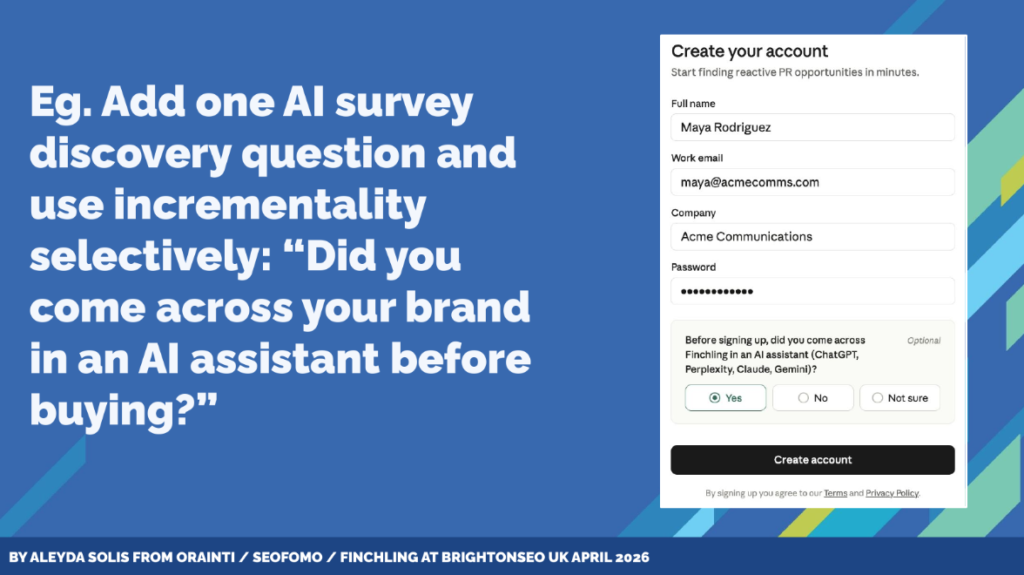
Useful inputs include AI referral sessions, AI conversion rate, branded search development or direct traffic to citation pages. As a TIP for better measurement, he mentions a simple question to ask the user at the registration/purchase or other conversion stage: "Did you come across our brand in AI assistant before making a purchase?"
Source: Aleyda Solis, BrightonSEO 2026
Three points to remember
AI referral traffic is only a minimum impact
Aleyda Solis says that traffic directly from AI tools is a "floor, not a ceiling", i.e. the lower limit, not the entire impact of AI. Some users will see a brand in an AI response, but later come through a Google, direct or brand query.
Brand signals can grow beyond direct AI visits
In the Aleyda example, it also showed +22% QoQ growth in branded search and +38% QoQ growth in direct traffic to a specific page.This suggests that AI could have influenced demand even without a direct click from the AI tool.
AI visibility without context can be deceptive
In another presentation, Cosmin Negrescu (founder and CEO of SEOmonitor) reminded us that visibility in AI answers alone is not enough. We need to know if a given prompt represents real demand, relevant intent and business value.
Otherwise, we can create a nice AI visibility report, but it won't explain traffic, demand or revenue. If we weight all prompts equally, we may overestimate topics that almost no one addresses in practice, and underestimate queries that actually influence buying decisions.
2. AI Search is not a single channel: ChatGPT, Google AI Mode and Perplexity behave differently
Another big topic: stop talking about "AI Search" as a single environment. Each platform has its own sourcing ecosystem, its own citation selection logic, and its own vulnerabilities.
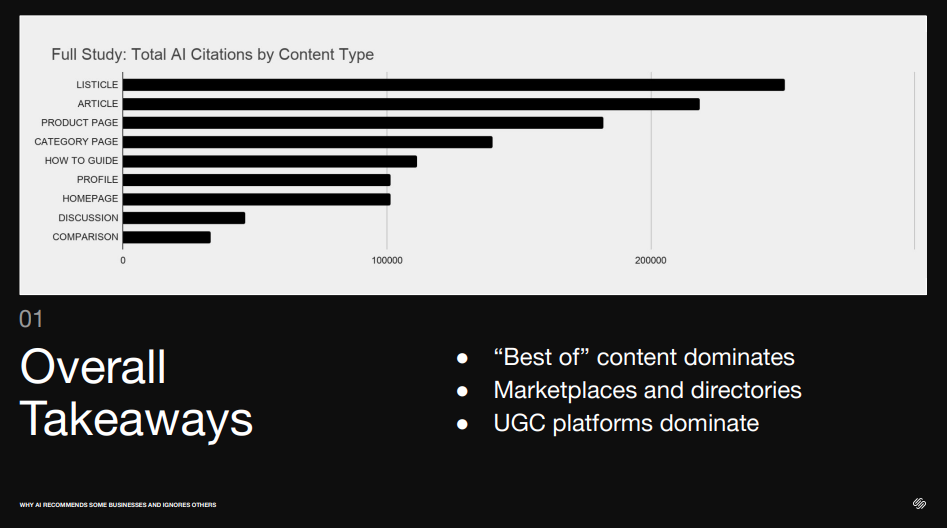
Tom Smeaton (SEO Manager at Squarespace) presented research in which Squarespace along with Peec AI analyzed 1.2 million citations across ChatGPT, Google AI Mode and Perplexity. The study focused on prompts that users search for related to professional services across three verticals: Health & Beauty, Professional Services, and Training & Education.
For professional services, AI does not have product data or SKUs (identifier of a specific product or product variant) as in e-commerce. It relies all the more on reputation, credibility, local signals and comparative content to make recommendations.
Source: Tom Smeaton, BrightonSEO 2026
In this context, ChatGPT reached more for articles (over 20% of citations), Google AI Mode reached more for social content (over 90% of all Instagram citations were in AI Mode and the remaining 10% in other platforms) and Perplexity reached more for listicle recommendations (over a third of all citations were listicles*).
* Listicles are articles built like lists. Typically "best X", "top 10 tools", "7 recommended agencies", "best salons in London", etc. In an SEO/AI Search context, these are mainly comparison and recommendation articles from which AI can easily take candidates for a response.
For services, it is not enough to have a well-written website. The tag must be present where the AI platform is looking for “evidence”, or the content it cites.
Source: Tom Smeaton, BrightonSEO 2026
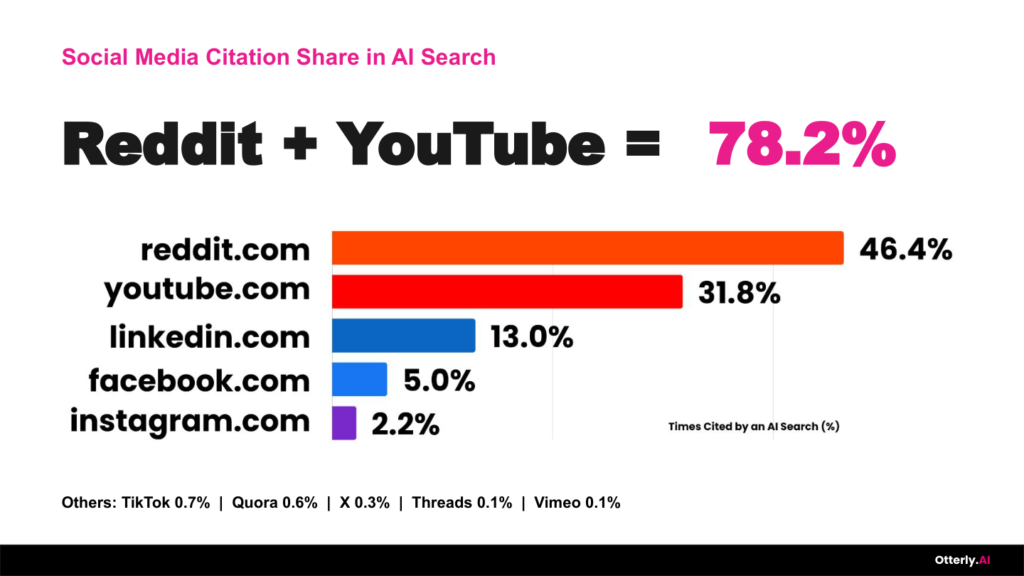
This idea was strongly supported by Rick Tousseyn' s (GEO Content Strategist OtterlyAI) talk on YouTube citations in AI Search (see below). His team analyzed 100 million AI citations across six platforms over 30 days. Of those, 5.5 million citations came from social and video platforms and 1.7 million came directly from YouTube. Interestingly, Reddit and YouTube together accounted for 78.2% of the social media citation share in AI Search.
Even more important than the numbers themselves was "platform fragmentation": more than 56.2% of YouTube AI citations came from Google AI Overviews and Google AI Mode. YouTube is easily the king in the Google AI ecosystem, while ChatGPT has Reddit and Copilot's LinkedIn as its strongest social feed, which makes sense given the Microsoft ecosystem.
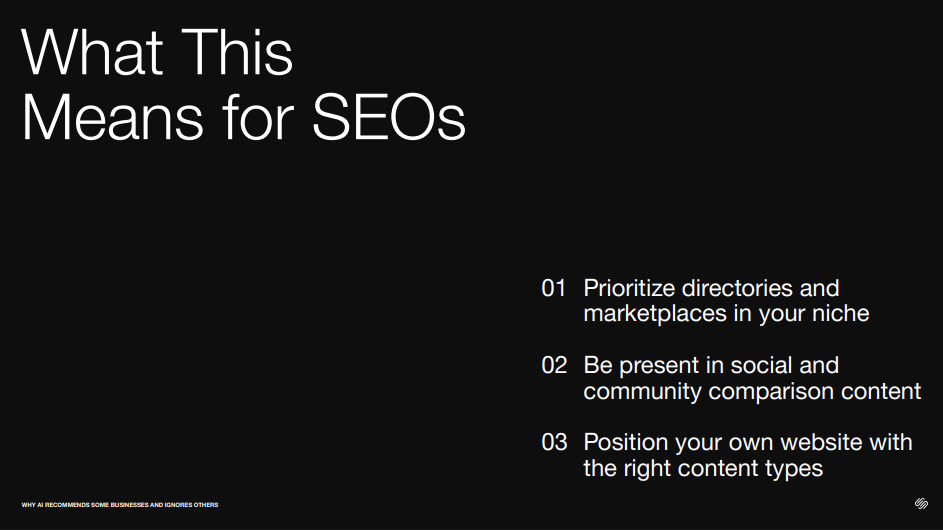
Tom's framework for visibility in AI search for services was based on three steps:
to push through the discovery phase,
get mentions in comparisons and on social platforms
and have a website with high quality, clearly structured content that AI systems can easily cite.
Sources that really help AI citations for professional services included industry directory sites, Yelp (an online directory and review portal for local businesses and services) and local profiles, niche editorial listicles, Instagram Reels for Health & Beauty, Google Maps as a foundation, and also a warning that relying only on a generic "Services/Services" page is not enough.
This is particularly important for small and medium-sized businesses. Previously, it was enough to address “do we have a good website?” Today, a more accurate question is “does the AI have enough independent evidence to recommend us?”
Daniel Procházka, SEO Team Leader
3. Technical SEO hasn't disappeared, it's just expanded to include AI crawlers, web fetch and agent access
Anyone who expected technical SEO to give way to brand and content in 2026 must have left BrightonSEO disappointed. Technical foundation is still the ticket to the game. It's just not just about Googlebot anymore.
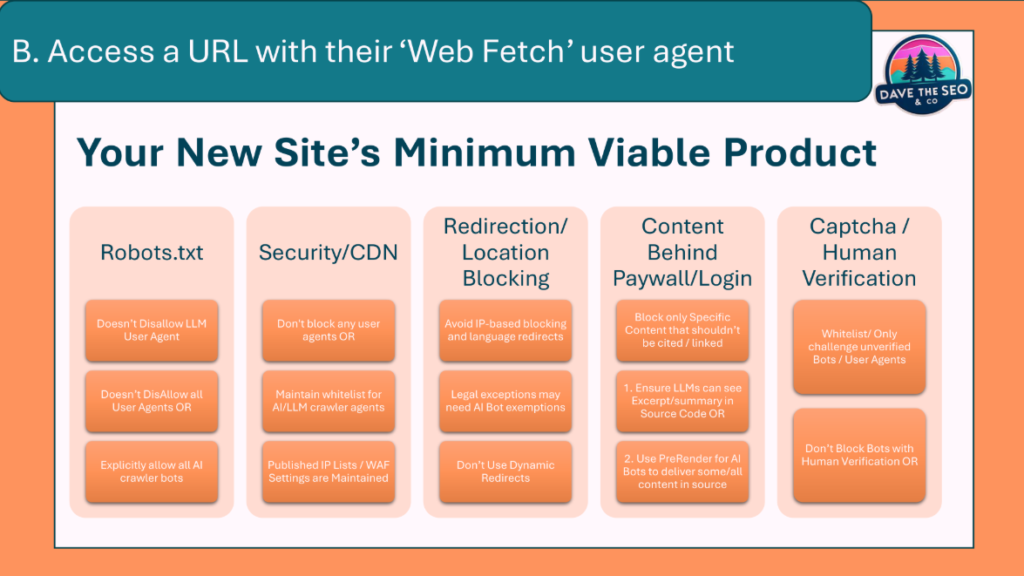
Dave Cousin (DavetheSEO), in a talk on future-proof migrations, showed that the web today must serve multiple types of "visitors" at the same time.
He described four front-end flows:
users,
browser-based AI working with a visual interface,
AI web fetch function,
future standards like WebMCP.
The fundamental difference is how they get to the content. People can handle the interface, even if it's not perfect. Browser-based AI attempts to interpret the web in a similar way to a human, but it can be slow, token expensive and can get stuck. AI web fetch is even more rigorous: it typically only pulls visible text from the source code, if it reaches the page at all.
Dave summarized the minimum for an AI-friendly site quite specifically:
pages must be visible in search results,
AI user-agent must get to the URL
and the key content must be available as visible text in the source code.
His "minimum viable product" for the new site includes robots.txt without blocking LLM user-agents, security and CDN settings that don't unnecessarily block AI crawlers, caution with IP-based redirects, paywalls, logins, captcha protections and human verification.
Source: Dave Cousin, BrightonSEO 2026
An important point from his presentation was that the biggest risk is not to migrate too early, but to migrate to a "brittle site", i.e. a site that is fragile, hard to extend and not ready for new protocols.
If the new site has JavaScript-only content, no API access, no custom fields, and no custom code, every other change can mean another rebuild. Conversely, a site with content in the source, an API-ready architecture, flexible fields, the ability to inject code, and reasonable authentication can be rebuilt to new standards rather than rebuilt.
How to approach the site when the migration has taken place and the results are bad
In his talk, Jeroen Driehuis (SEO Specialist at Onder) approached migrations as a six-step diagnosis. He described the process he follows when a client contacts him after a site migration associated with a drop in sales, traffic or other issues.
Before even starting to evaluate what went wrong, he recommends finding out the context: why the migration took place, what the objectives were, what decisions were made and what technical constraints the project had.
He also points out an important point: a drop in traffic or visibility does not automatically mean a bad migration. First you need to collect data from GA, GSC, backlink profile, old crawls, Wayback Machine and SERP history.
His six-step approach starts with the question of whether the important pages are still available at all. It then addresses crawlability: whether user-agents can see important pages, whether robots.txt is blocking something crucial, whether internal links have nofollow, whether sitemaps are problematic, and whether orphan pages have arisen.
First, the main goal is to find out what was important before the migration: pages, queries, conversions, decisions and technical limitations. Then break the problem down through accessibility, crawlability, indexability, renderability, interpretability and clickability.
For rendering, he pointed out JavaScript dependencies, interaction-dependent content, and differences between raw and rendered HTML. For interpretability, he pointed out structured data, heading hierarchy, and matching content to user intent.
The bottom line is simple: AI search has not “abolished” technical SEO. It has become a necessity. If the page is not accessible, readable, renderable and understandable, it will not reach either the human or the model. And if the site is built in a brittle way, without control over content, APIs, logs, CDNs and rendering, it will become increasingly difficult to respond to new AI interfaces, crawlers and protocols.
Three important points to remember
AI bot is not just the new Googlebot
Different AI systems approach the web differently: some pull text from the source code, others try to interpret the visual interface, and still others will work through protocols and endpoints. The web therefore needs to be readable by humans and machines.
Migration is not just a redirect map
Migrations need to address content availability, crawlability, sitemap, internal links, URL structure, canonicaly, duplicate content, product clusters and platform restrictions.
The future of technical SEO is flexibility
The goal is not to bet everything on one protocol, but to be protocol-agnostic: to have content available in the source, API-ready architecture, custom fields, code customization, control over CDN and logs.
4. Entity SEO: From a "string of words" to a recognizable thing
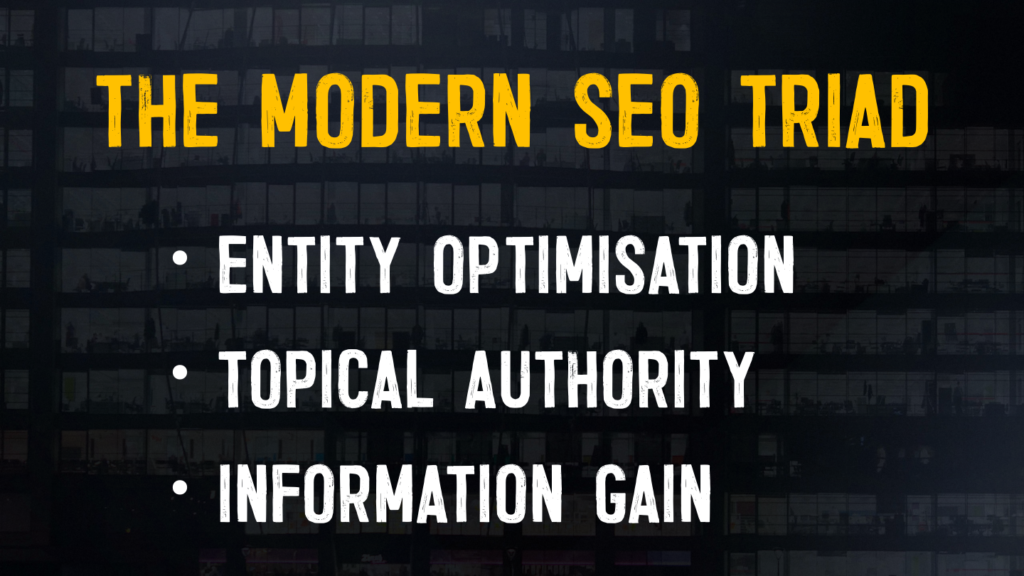
One of the biggest shifts in thought was in relation to entities. Felipe Bazon (SEO Manager at HEDGEHOG) in his presentation formulated the modern SEO triad: Entity Optimisation, Topical Authority and Information Gain. According to him, keywords alone are not enough anymore, because Google and AI systems have shifted to understanding topics, concepts and entities.
Source: Felipe Bazon, BrightonSEO 2026
Entity SEO defined it as reducing ambiguity around a brand so that search engines and AI systems understand as an entity, not just a string of text.
In practice, this means making it clear who the brand is, what it does, what themes it should be associated with and what signals support its legitimacy. Felipe sums it up as the brand moving from "string" mode to "thing" mode.
He showed it well with the example of the word Hedgehog. The same expression can mean an animal, an agency or a band. Only the context, related entities, properties and relationships determine which "thing" the system should select.
This is the essence of Entity SEO: it's not enough for the brand name to be repeated somewhere. The system needs to understand what the entity is, in what context it exists, and what it should be associated with . In his presentation, Felipe mentions that the Knowledge Graph draws on Wikidata and Wikipedia, licensed datasets, structured data from crawled pages, and references from other authoritative entities, among other things.
This builds on information from Genie Jones (inLinkds) talk on AI Visibility. Her main argument was that AI systems don't reward a brand for repeating the correct phrase on a page. They need the brand to be clearly identifiable as a company, person, service, place or product that the knowledge graph understands. Practically, this means a clean schema, structured "About Us" pages, consistent naming across the site, and links to authoritative sources where they make sense.
Interesting practical detail from the handout: for a markup scheme, one isolated type is not enough. For more complex sites it makes sense to link Organization, LocalBusiness, Service, Person, FAQPage, or BreadcrumbList using @id so that Google and AI systems can see the relationships between business, people, services, and locations as a whole.
5. Topical authority is no longer enough, content must deliver "information gain"
Felipe Bazon went even further. Topical authority remains key, he says, because in AI Search it helps a site become a trusted source in a particular situation. It is built through topical maps, entity research of brands, products and authors, content hubs and clusters, supporting articles, custom research, videos, social distribution and entity link building.
But authority itself is just an invitation to a party.
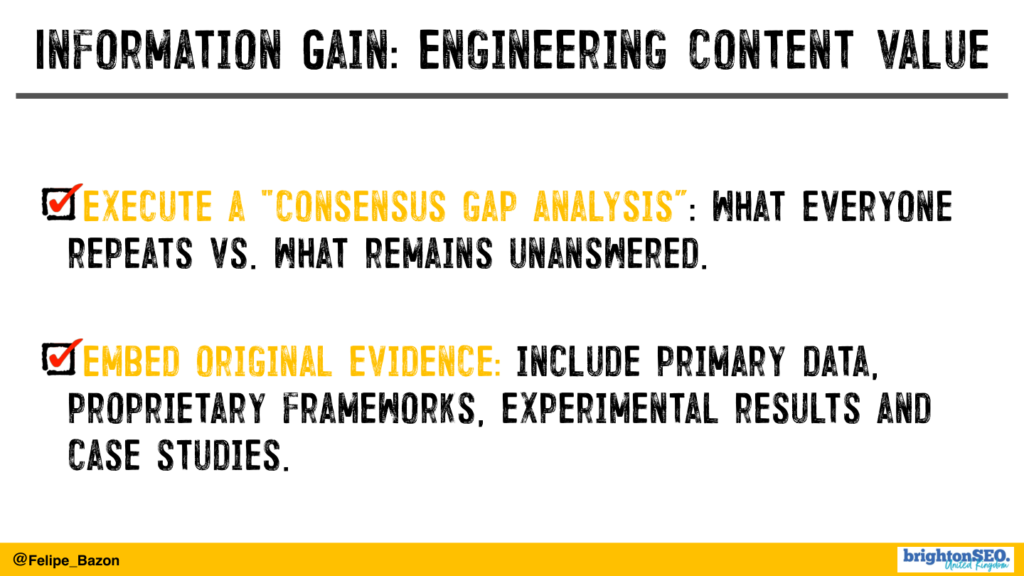
For the system to really listen to you, you need information gain, i.e. a unique baseline value compared to what already exists on the site.
Source: Felipe Bazon, BrightonSEO 2026
Felipe describes this as content that doesn't give the AI its own training data back in a different form, but brings something the system doesn't yet "know": its own data, new perspectives, unique experiences, different conclusions, or original analysis.
This is also important for content strategy. In the AI era, it’s not enough to write “the best guide to topic X” if it’s just a summary of the first ten results. The better question is: What can we add that no one else has?
6. Reddit and UGC: AI wants human answers, not corporate brochures
Reddit was one of the most visible topicsat BrightonSEO. Not as "just another social network" but as a data source for search, AI answers and brand perception.
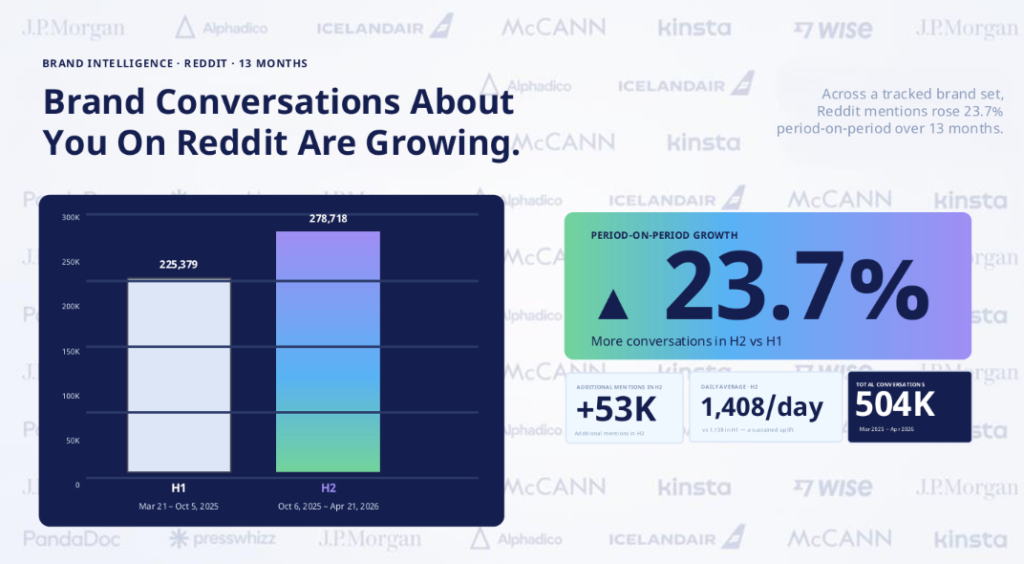
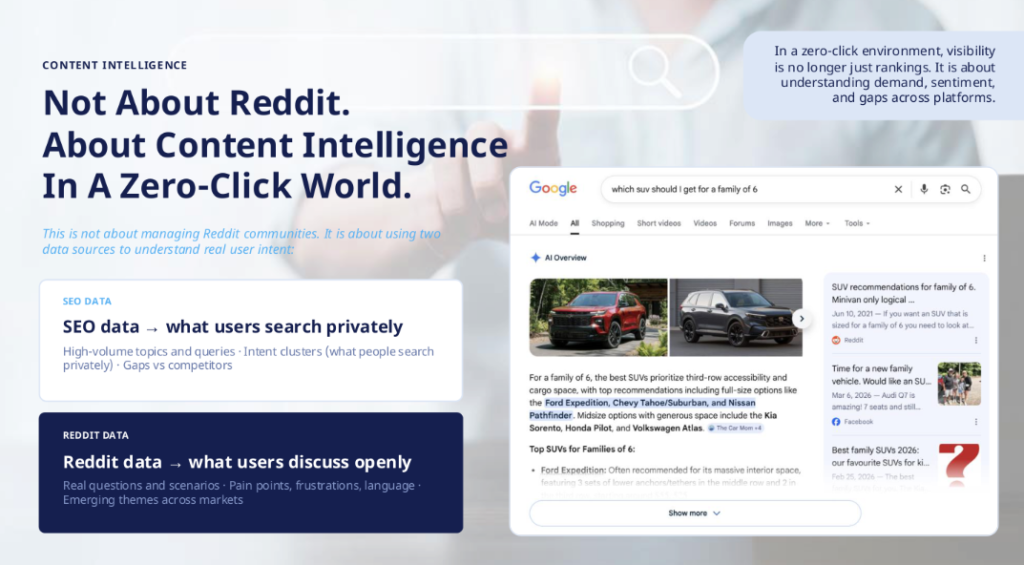
In her presentation on the zero-click world, Ainhoa Lizarralde (International Head of SEO at MarketFully Group) showed that for the set of brands studied, brand conversations on Reddit increased by 23.7% in 13 months. There were 504k conversations in the data between March 2025 and April 2026, with the latter period adding over 53k extra mentions.
Source: Ainhoa Lizarralde, BrightonSEO 2026
The numbers are even stronger: according to the presentation, 73% of companies had Reddit threads on the first page of results for brand queries.
So Reddit isn't just a place where people talk. It's often the public layer of brand reputation that Google, users and AI systems see.
Ainhoa also stressed that the point is not to "do Reddit strategy" at all costs. The point is to use Reddit as a source of content intelligence in a zero-click world. SEO data shows what people are searching for privately. Reddit data shows what people are talking about openly: how they describe their problems, what scenarios they solve, what wording they use, and what really interests them about brands.
Source: Ainhoa Lizarralde, BrightonSEO 2026
This is a big difference from traditional keyword analysis. Keywords often capture demand, but they don't always capture the frustrations, doubts, comparisons, trade-offs and real language of customers. Reddit, on the other hand, shows how people talk when they are not in "search mode" but in conversation with others.
Victory Umurhurhu-Michael brought authenticity into the mix. Her presentation highlighted that people want answers that actually sound human. Reddit is therefore gaining importance through the combination of AI Search, user-generated discussions, search intent, and forum results. But she also pointed out that Reddit is not a place for corporate self-promotion. Redditors have a high trust barrier, give tough but authentic feedback, and do not tolerate self-promotion.
Her presentation also included interesting data on the role of Reddit in the customer journey: 71% of people who discovered a brand elsewhere subsequently researched it on Reddit, and 88% of users made a purchase decision based on information found on Reddit.
7. YouTube as a quotable source: it's not the biggest channel that wins, but the best answer
The data from Rick Tousseyn of OtterlyAI was also highly interesting. Their YouTube AI Citation Study analyzed 100 million AI citations across six platforms over a 30-day period.The data from Rick Tousseyn of OtterlyAI was also highly interesting. Their YouTube AI Citation Study analyzed 100 million AI citations across six platforms over a 30-day period. Out of that, 5.5 million citations came from social and video platforms, with 1.7 million from YouTube. Reddit and YouTube together accounted for 78.2% of social media citation share in AI Search
Source: Rick Tousseyn, BrightonSEO 2026
YouTube is particularly strong in the Google ecosystem: more than 56.2% of YouTube AI citations came from Google AI Overviews and AI Mode. Rick also showed that 94% of AI citations were directed at long-form videos, while Shorts accounted for only 5.7%. The most commonly cited video range was 5-20 minutes, which included 58.2% of cited videos.
The biggest surprise? Popularity barely correlated with citations.
The number of views, likes and subscribers did not have a significant correlation with citation frequency. In contrast, the video description and metadata had a weak but positive signal. Even 40.8% of cited videos had less than 1,000 views, 36% had less than 15 likes, and 35% of cited channels had less than 10,000 subscribers.
The practical conclusion? Build videos as documentation, not just entertainment. Long-term valuable explainer videos, tutorials, comparisons, walkthroughs, and case studies with chapters, timestamps, and metadata-rich descriptions are more quotable for AI than short viral content with no structure.
8. Audience research before optimization.
Alongside all the technical and AI topics, there was one other healthy reminder in Brighton that I'm always happy to mention: we're still optimising for humans.
Emina Demiri-Watson (Vixen Digital) showed a simple but powerful example in her presentation "Before cosine and fan-out, there is audience". The client had a word in the navigation that the whole team was using internally, but the target group didn't understand it.
After changing the terminology to the language of the audience, within three weeks there was a 64% increase in revenue, a 567% increase in key events and 160 new users compared to 24 before the change.
Emina didn't just base her audience research on keyword analysis. She combined several sources to help her understand how people really talk about the topic, what they perceive positively or negatively, and what issues recur across different channels.
She pulled out recurring themes and sentiments from reviews on Trustpilot, i.e. whether people were talking positively, negatively or neutrally about a particular issue. Using Google Cloud NLP, she analyzed entities, i.e., specific brands, products, features, places, or terms that appear in the texts.
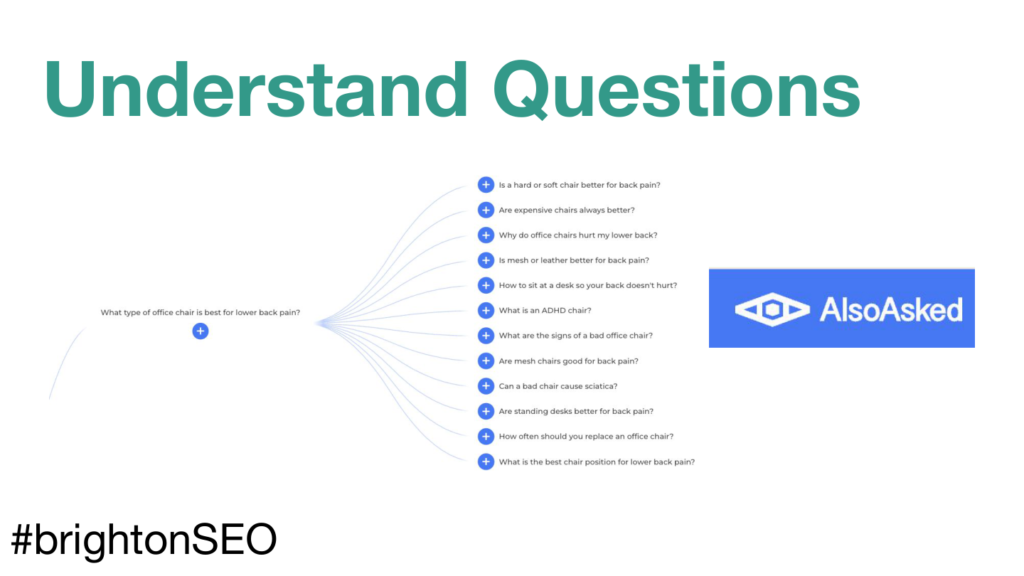
She used Reddit as a source of natural discussions. Using Reddit Topic Cruncher and BERTopic, she was able to pull out the main topics that people spontaneously address from multiple threads. Finally, through AlsoAsked, she tracked the questions users were asking in search.
Source: Emina Demiri-Watson, BrightonSEO 2026
So the goal was not just to create a list of questions for the content plan. It was about understanding what entities people mention, in what context, with what emotion, under what topics, and where there are gaps between what the brand is communicating and what the audience actually needs to hear.
This is an important counterbalance to the AI hype. Yes, we can (and I recommend) addressing fan-out queries, embeddings, entity density, and citation graphs. But if we're using a language spoken by the internal team and not the customer, the whole strategy breaks down at the first level.
9. Automation, MCP and agent SEO: SEO specialist as a system organizer
Another significant line was automation. But not in the sense of "AI will write 500 articles for us", but in the sense of connecting tools, data and workflow so that the SEO specialist doesn't have to manually do the work over and over again, which can be safely handed over to the system.
Gus Pelogia (Indeed) showed the practical use of MCP servers for SEO. He described the Model Context Protocol as an open-source standard from Anthropic that allows AI models to securely connect to external tools.
Source: Gus Pelogia, BrightonSEO 2026
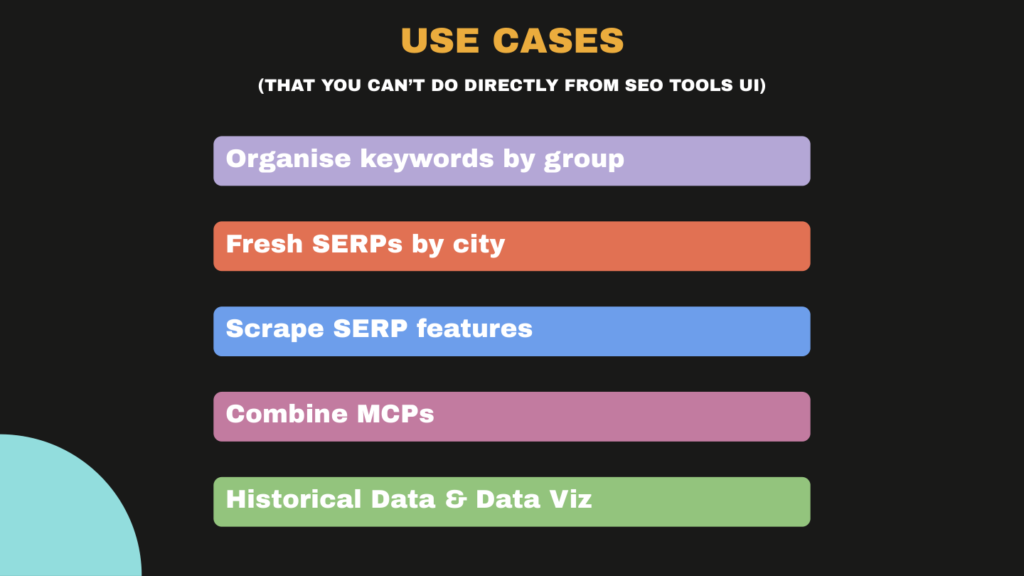
His use-cases were very practical: organizing keywords into groups, fresh SERPs by city, scraping SERP features, combining MCP tools and historical data with visualization. For example, for keyword grouping it showed the output of 87 keywords in one line, for local SERPs it solved the situation when you need fresh results from another location without manually setting up Chrome.
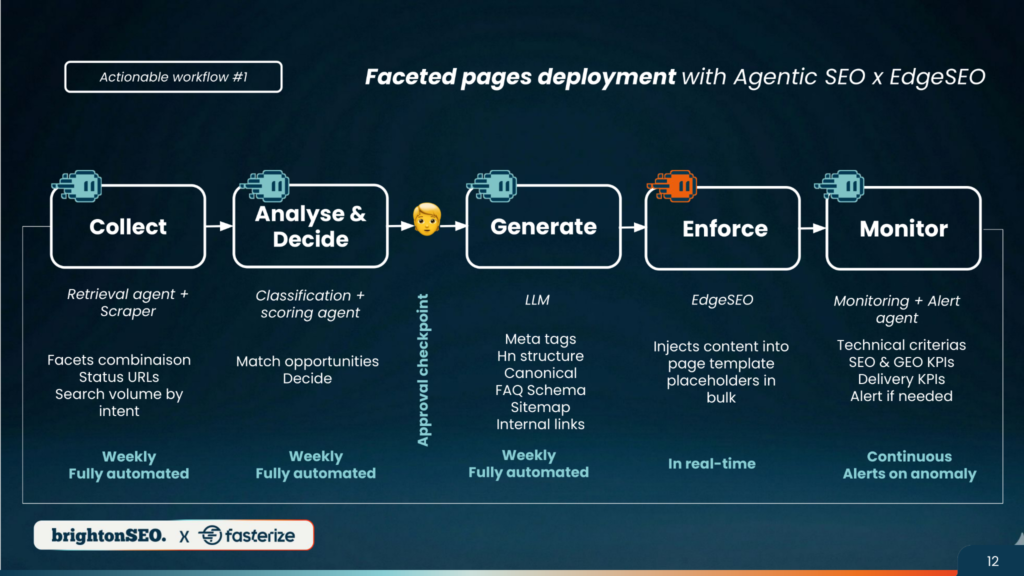
Valentine Jahan (Fasterize) showed a combination of Agentic SEO and EdgeSEO. In one workflow she worked with faceted pages: data collection, analysis, decisions, metadata generation, canonicals, FAQ schema, sitemaps and internal links, deployment on edge and monitoring.
In the second workflow, she handled the enrichment of more than 2,000 store pages for SEO and AI Search. The result of the presented retail example: 2,000+ automatically enriched pages, ten times more SEO clicks in four months, 5,000+ keywords in the Top 10 and citations in ChatGPT, Gemini and Claude.
Source: Valentine Jahan, BrightonSEO 2026
So automation is not just “let’s do more texts” as many people approach it. The stronger direction is organization: agent collects data, evaluates opportunities, suggests changes, human approves, and edge layer deploys in bulk.
SEO specialist does not move into the role of a person who manually checks and rewrites everything. He moves into the role of a system architect: setting rules, controlling quality, setting priorities and deciding what can be automated and what must remain under human supervision.
10. Server logs as content radar
Yvie Ansari (Head of SEO at Snaptrip Group) reminded us of a tool that is still little used in regular content strategies: server access logs. Not as the only source of truth, but as a supplement to user data.
She herself pointed out at the beginning that content strategy should not be based only on examining access logs - it must always be based on users and their behaviour. But logs help to understand if important content is getting in front of bots at all and how different crawlers are discovering it.
Her recommendation: follow Google by default, but add Bing, ChatGPT, Perplexity and Claude. Because as we know, in the AI era, it's not enough to know what Googlebot is doing. It's important to see if and how AI crawlers and other systems that can influence brand visibility are also accessing content.
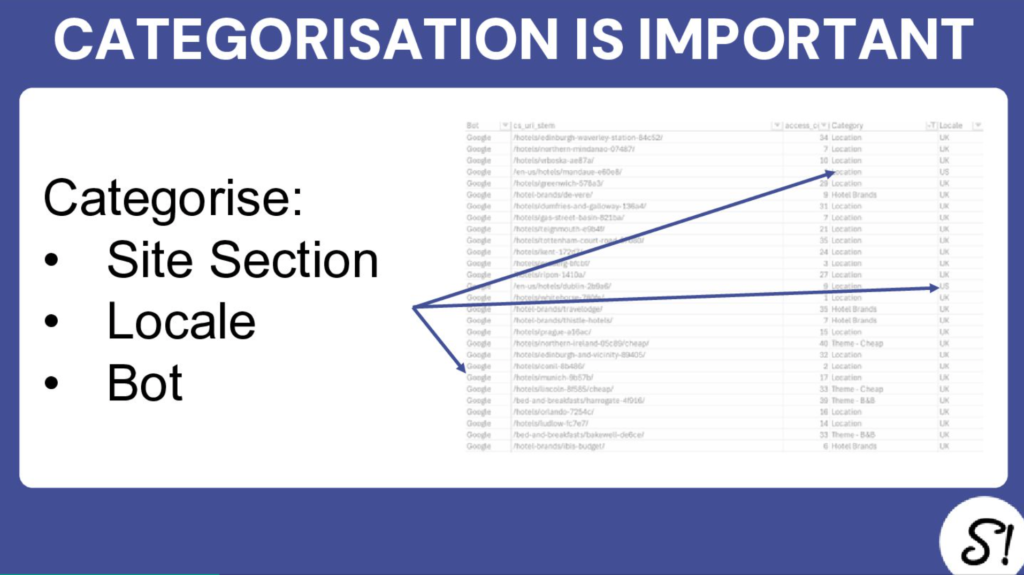
Categorisation is key, she said. It's not enough to just have a list of URLs visited. Logs only become useful when you categorize URLs by site section, locale, and bot. Only then can you see which content clusters the bots are visiting, which they're ignoring, and if certain parts of the site are out of their reach.
Source: Yvie Ansari, BrightonSEO 2026
According to Yvie, the logs can be used to hypothesize and answer questions such as:
What content is likely to be powerful?
Do bots "like" new content?
Is the site missing any content that bots expect?
Are there parts of the web that LLM or Google can't reach at all?
This is especially important for large sites, where some pages may be technically accessible but virtually undiscovered.
Validation through GA then helps to understand whether the content works for humans, not just bots. In other words, high bot access with low performance may indicate a quality, intent or E‑E-A‑T problem. Conversely, important content with low bot access may be an opportunity for better internal linking, sitemap or technical hurdle removal.
What to take away from BrightonSEO 2026?
I think BrightonSEO 2026 showed one main thing: SEO is not falling apart. It just ceases to be (and hasn't really been for some time) an isolated discipline.
Technical SEO remains the foundation. Without an accessible, readable, and well-structured site, a brand won't be seen by either search engines or AI crawlers. But today, technical SEO doesn't stop with Googlebot. We have to account for web fetch functions, various user-agents, rendering, logs, structured data, and just how easily machines can actually read the content.
Content is still key. But it’s not enough to just cover keywords. Content must speak the language of the audience, be anchored in entities, provide original data, experience, or a new perspective, and be written in a way that makes it highly quotable. An average summary of what already exists elsewhere will become increasingly insufficient in the AI era.
Brand is more important than ever. Not just on the web, but in listicles, reviews, communities, videos, local profiles, social signals, and third parties that AI systems trust. The question is no longer just "what are we saying about ourselves" but "what is the entire ecosystem saying about us".
And the measurements have to change. The cranks haven't gone away, but they're no longer the only evidence of value. We will need to track visibility, brand representation, citation quality, brand traffic and search traffic, direct traffic, surveys, indirect signals and modelled impact. Not to artificially take credit, but to better understand where SEO really influences decision making.
The shortest summary of the whole conference could be:
SEO in 2026 is no longer a fight for positions, but a fight for credibility in the answer ecosystem.
And the winner will be the one who is understandable for humans, readable for search engines and verifiable enough for AI.
Daniel Procházka, SEO Team Leader
Daniel Procházka
SEO Team Leader
Dan wanted to do creative marketing and come up with campaigns. But then he stumbled upon SEO and he was done. He got into the world of search engines in 2020 through managing an e‑commerce store and has enjoyed both the technical side of SEO and working with content ever since. He’s not just about getting sites to the top ranks, but also making sure clients understand why and how they get there. That’s why he doesn’t just work on SEO, he explains it — because when a client understands what’s going on, it’s much easier to fine-tune the strategy and the whole project grows.

 Daniel Procházka, SEO Team Leader